Press Releases
Trahan’s Bipartisan App Store Freedom Act Featured in Legislative Hearing
WASHINGTON, DC ,
July 22, 2026
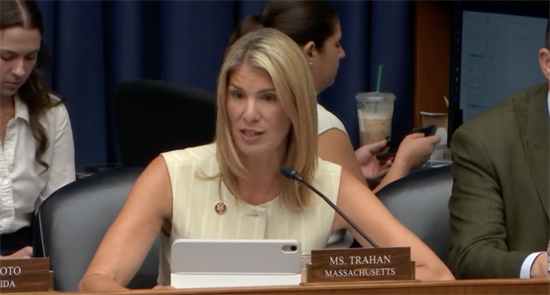
Today, Congresswoman Lori Trahan (D-MA-03) touted her App Store Freedom Act (H.R. 3209) during a House Energy and Commerce Committee hearing on “Legislative Proposals to Strengthen Consumer Protection in a Changing Marketplace.” The bipartisan bill, introduced alongside Congresswoman Kat Cammack (R-FL-03) last year, would open up the mobile app marketplace to real competition. “Smartphones are the front door to modern life, but Apple and Google control that door. Together, their operating systems power more than 99 percent of U.S. smartphones. Apple controls all native iOS app distribution in this country, while Google controls roughly 90 percent of Android app distribution,” Congresswoman Trahan said. “That’s not a competitive market, it’s a duopoly. Apple and Google can force developers into their payment systems, charge commissions of up to 30 percent, block customers from hearing about lower prices, and give their own apps an edge. That means consumers pay more for less choice and less innovation.” During the Committee hearing, Trahan spoke about the importance of the legislation. Footage of her remarks can be accessed HERE or by clicking the image below. A transcript is embedded below.
During her remarks, Trahan pointed out that just two companies – Apple and Google – control almost all of the app distribution on iOS and Android devices. Together, they have taken steps to eliminate competition, allowing them to set their own rules, charge extreme fees to app developers, and copy, punish, or outright block apps that they view as conflicting with their own business priorities. The App Store Freedom Act would ensure that consumers have the ability to install third-party app stores, sideload apps, and delete pre-installed ones they don't want. It would also give developers free, equal access to the tools they need to compete and stop dominant app stores from forcing developers into proprietary payment systems or punishing them for offering better deals elsewhere. “H.R. 3209 does not set prices or pick winners,” Congresswoman Trahan continued. “It makes powerful gatekeepers compete, so consumers – not corporations – decide which apps and services work best for them.” The bipartisan bill is backed by a broad coalition of small and medium sized developers and pro-consumer and pro-competition advocacy groups. --------------------------------------- Congresswoman Lori Trahan Remarks as Delivered House Energy and Commerce Committee Hearing on “Legislative Proposals to Strengthen Consumer Protection in a Changing Marketplace” July 22, 2026 Well. Thank you, Ranking Member Schakowsky, I also want to thank the Chairman. Today I’m so glad to see H.R. 3209, the bipartisan App Store Freedom Act, on today’s agenda, and I’m grateful to my co-lead Congresswoman Kat Cammack for her tireless work on this bipartisan legislation. Smartphones are the front door to modern life, but Apple and Google control that door. Together, their operating systems power more than 99 percent of U.S. smartphones. Apple controls all native iOS app distribution in this country, while Google controls roughly 90 percent of Android app distribution. That’s not a competitive market, it’s a duopoly. Apple and Google can force developers into their payment systems, charge commissions of up to 30 percent, block customers from hearing about lower prices, and give their own apps an edge. That means consumers pay more for less choice and less innovation. A new economic analysis published this week quantifies the harm. Americans spend $52.3 billion annually through Apple and Google’s app stores. If competition pushed down app store fees, consumers could save about $8.9 billion each year. The App Store Freedom Act targets only the largest gatekeepers and offers a pro-market fix. It lets consumers choose alternative stores and default apps, install apps outside the dominant stores, and remove unwanted preloaded apps. It stops forced payment systems and gag rules, and it gives developers fair access to operating-system features so they can compete on merit. Opponents say exclusivity is the price of security. It’s not. They argue that opening app distribution and alternative app stores will invite malware, scams, and threats to children. And sure, alternative distribution can create risks if poorly managed, but the status quo is already unacceptable. Documented scams and unsafe apps like nudify apps routinely slip through Apple’s and Google’s security reviews. The answer is strong safeguards, not permanent monopoly control. To be absolutely clear, nothing in this bill forces someone to use an alternative app store. Apple and Google can keep operating and vetting their own stores. It does not require them to provide support for third-party apps, and it preserves intellectual-property and national-security safeguards. We know openness and security can coexist. Google’s Play Protect scans Android apps from outside its store and Apple secures software outside the Mac App Store. Competition could also produce safer choices, including stores designed specifically for families and children. Security is an engineering challenge, not a monopoly entitlement. H.R. 3209 does not set prices or pick winners. It makes powerful gatekeepers compete, so consumers – not corporations – decide which apps and services work best for them. Chairman Guthrie, Chairman Bilirakis today is an important first step. I urge the committee to continue to work with Congresswoman Cammack and myself to break the duopoly and allow competition in the mobile app space. American consumers have waited long enough. ### |