Press Releases
Trahan Backs Bipartisan Bills to Protect Ratepayers from Data Center Price Hikes
WASHINGTON, DC,
July 21, 2026
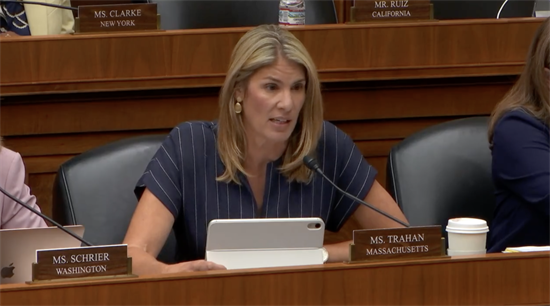
Today, Congresswoman Lori Trahan (MA-03) supported the passage of two bipartisan pieces of legislation to protect ratepayers from increased utility costs caused by data centers during a House Energy and Commerce Committee markup. Both bills, the Ratepayer Protection Act and the Protecting Families from AI Data Center Energy Costs Act, are now eligible for consideration on the House floor. “It’s our job to make sure that when data centers are built, they're built on terms that work for the families who live nearby,” Congresswoman Trahan said. “That's what this legislation gets right. It says something simple. If you build the data center, you pay for the data center. The construction costs, the utility costs – those fall on the company, not the family down the street. This bill gives states a strong standard to make sure large load developers foot that bill themselves.” During the Committee markup, Trahan spoke in favor of both pieces of legislation. Footage of her remarks can be accessed HERE or by clicking the image below. A transcript is embedded below.
Data centers are the fastest-growing source of new electricity demand in the country, and the grid upgrades needed to serve them are not free. Someone has to pay for the new power plants, transmission lines, and substations, and too often that cost gets spread across everyone's monthly bill, leaving families and small businesses to subsidize the energy needs of some of the largest corporations in the world. To combat this problem, the Ratepayer Protection Act gives state utility regulators clear standards to ensure large-load customers, meaning any new data or information storage facility drawing 100 megawatts or more, cover the full cost of the infrastructure they require. It requires those customers to recover the full incremental cost of grid upgrades over time and to provide financial assurances, so ratepayers stay protected even if a data center scales back or leaves entirely. Similarly, the Protecting Families from AI Data Center Energy Costs Act directs the Federal Energy Regulatory Commission to convene major stakeholders to examine how to shield residents from these rising costs, and it requires FERC to deliver a report with concrete recommendations and best practices so the energy costs tied to AI data centers are not passed on to ordinary consumers. During her remarks, Trahan pointed out that both bills are important first steps in protecting families from bearing the burden of increased utility costs caused by data centers. She argued that Congress must go further, including by passing a provision in her bipartisan Great American AI Act discussion draft released last month to improve data center efficiency and reduce their environmental footprint. “Both of these bills are good first steps, Mr. Chairman, but we should also be honest about what they don't do. They don't fully address the water these facilities draw from our communities. They don't answer the concern back home that when the grid is stretched, families worry they'll be deprioritized,” Congresswoman Trahan continued. “People in the district I represent are raising these questions, and they deserve answers. That's exactly why, when Congressman Obernolte and I drafted the Great American AI Act, we included provisions to make data centers more efficient and lessen their environmental footprint. Because the smarter we build these facilities, the less strain they put on the grid, on our water, and on the families who live nearby.” Both bills passed unanimously and now move to the House floor for consideration by the full House of Representatives. ----------------------------------- Congresswoman Lori Trahan Remarks as Delivered House Energy and Committee Markup July 21, 2026 Thank you, Mr. Chairman. I too support the Ratepayer Protection Act and look forward to advancing this bipartisan legislation to the House floor today. Right now, families across our country are afraid to open up their electric bills. The number keeps climbing, and their paycheck isn't keeping pace. They're doing the math at the kitchen table, wondering what they might have to cut next just to keep the lights on. That fear is real, and too many families have stopped believing that anyone in Washington is listening. They watch prices rise at the pump and at the grocery store. They sit through weeks of brutal heat and run the air conditioning that they can barely afford. And now they read that a data center is coming to their community, and they are told not to worry about what that means for their bills. Well, to be clear, data centers aren't going away. So it’s our job to make sure that when data centers are built, they're built on terms that work for the families who live nearby. That's what this legislation gets right. It says something simple. If you build the data center, you pay for the data center. The construction costs, the utility costs – those fall on the company, not the family down the street. This bill gives states a strong standard to make sure large load developers foot that bill themselves. That's a real move toward keeping these costs off our constituents' bills. I'm also glad H.R. 6529, the Protecting Families from AI Data Center Energy Costs Act, is part of today's markup. It's another effort to make sure surging demand from these massive projects doesn't land on the backs of residential ratepayers. Both of these bills are good first steps, Mr. Chairman, but we should also be honest about what they don't do. They don't fully address the water these facilities draw from our communities. They don't answer the concern back home that when the grid is stretched, families worry they'll be deprioritized. People in the district I represent are raising these questions, and they deserve answers. That's exactly why, when Congressman Obernolte and I drafted the Great American AI Act, we included provisions to make data centers more efficient and lessen their environmental footprint. Because the smarter that we build these facilities, the less strain they put on the grid, on our water, and on the families who live nearby. So, these bills can't be where our work ends. AI is spreading through every corner of our economy, and hardworking Americans cannot be an afterthought while that happens. I commend the sponsors and Committee staff for their work on this legislation. It really matters. And I look forward to continuing this track record of bipartisan work on AI in the weeks and months ahead. ###
|